Stainless Steel Flanges for High-Temperature Applications
Stainless steel flanges are connecting elements that securely join pipe sections and lines, close them off, or adapt them to adjacent components. In thermally highly stressed plants, conventional flange materials are not sufficient. Special stainless steels with high scaling and oxidation resistance are the right choice here: permanently resilient at temperatures from 800 °C to over 1,100 °C.
At its site in Rastede, WITTE HiTEMP stocks weld neck flanges, blind flanges and further flange types made of heat-resistant stainless steels on around 12,000 m² of warehouse space. Special dimensions can be supplied at short notice through a worldwide supply network or the company’s own turning shop.
Which flange types are available?
Various flange designs are available for different installation situations and requirements:
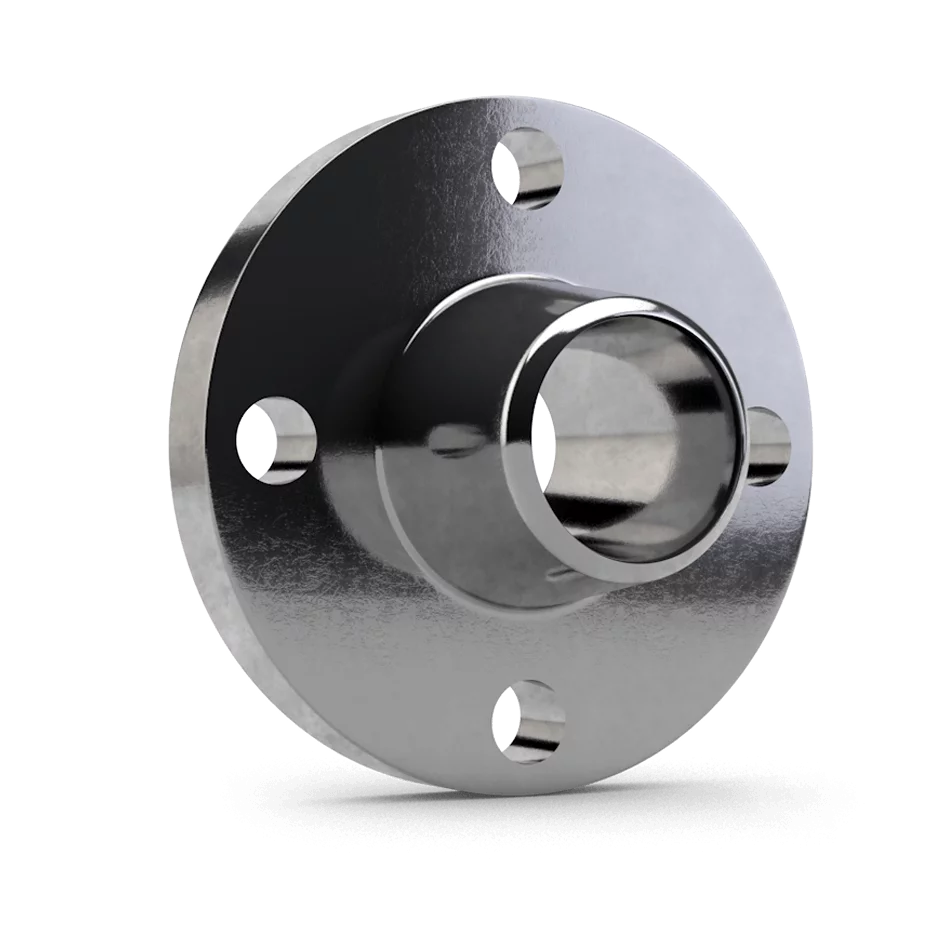
Weld neck flange
The weld neck flange is welded directly to the pipe and forms a permanently rigid, pressure-tight connection. It is the most frequently used flange type in industrial piping and is particularly suitable for high pressures and operating temperatures. Combined with heat-resistant stainless steel pipes made of the same materials, the result is a perfectly matched piping system.
Blind flange
Blind flanges close off pipelines or openings pressure-tight. They are used when a pipe run is to be terminated, an opening needs to be blocked off temporarily, or a maintenance access has to be covered.
Plate flange
For connections with lower pressure requirements, the plate flange offers an easy-to-install solution. It is suitable for applications where welding into the pipe is not required.
Custom flange to drawing
Custom-made flanges according to customer drawings for specific installation situations that cannot be covered by standard designs. Manufactured in the company’s own turning shop at the Rastede site.
Adapter flange
A special design for specific transition situations: the adapter flange. It connects a round piping system to a rectangular opening in a housing, a duct or a machine. More on this in the following section.

What is an adapter flange and when is it needed?
The adapter flange is a transition element between two geometrically different systems. It connects a round piping system, classically with a bolt circle, to a rectangular opening in a housing, duct or machine.
The need arises from a simple fact: pipes are usually round, whereas machines and ducts are often rectangular. Without such transition elements, many plants simply cannot be connected.
Typical applications for the adapter flange:
● Ventilation and extraction systems
● Mechanical and plant engineering
● Process engineering
For high-temperature applications in which the transition is permanently exposed to heat, material selection is crucial for the adapter flange as well. Standard stainless steels lose their resistance at temperatures above 600 °C, while heat-resistant alloys such as 1.4841 or 1.4845 continue to perform reliably in such environments.
Which materials are available for heat-resistant flanges?
The high-temperature materials used have been specially developed for continuous operation under extreme thermal loads. They are characterised by high scaling resistance, oxidation resistance and creep strength.
● 1.4828 | AISI 309: good scaling resistance, up to approx. 1,050 °C
● 1.4841 | AISI 314: very high scaling resistance, up to approx. 1,150 °C
● 1.4845 | AISI 310 S/H: excellent high-temperature strength, up to approx. 1,100 °C
● 1.4878 | AISI 321 H: titanium-stabilised, creep-resistant under continuous load
● 1.4835 | 253 MA: high yield strength, oxidation resistance up to 1,100 °C
To which standards are stainless steel flanges manufactured?
The flanges are manufactured to internationally recognised standards and are supplied as standard with inspection certificates to EN 10204. Further testing and customer-specific certification are available on request.
Applicable standards:
● EN 1092-1: European standard for steel flanges
● EN 1759-1: flanges to the American-European standard
● ASME B16.5: American standard for pipe flanges and flanged fittings
● Customer drawings: manufacture to individual specifications
Coverage of both standard families makes the flanges suitable for international projects in petrochemicals, power plant construction and plant engineering worldwide.
Which applications are heat-resistant stainless steel flanges suitable for?
Heat-resistant stainless steel flanges are used wherever piping systems are permanently exposed to high temperatures while at the same time having to meet high demands on tightness and mechanical strength:
● Thermal process plants in the chemical and petrochemical industries and in refineries
● Power plants and energy generation, for flue gas routing, heat exchangers and steam systems
● Industrial furnace systems such as reformers, furnaces and heating installations
● Exhaust systems with catalytic converters and high-temperature lines
● Steelworks and smelters in areas directly exposed to heat
In all of these areas, what matters is not just a single temperature peak but long-term durability under continuous thermal stress and temperature cycling.
What is the difference between fittings and flanges?
Fittings such as elbows, tees or reducers are pipe components that are permanently welded to the pipe and create changes of direction, branches or cross-section transitions within a pipeline. Flanges, on the other hand, sit at the ends of pipes or components and enable detachable connections to other pipe sections, vessels or machines. In short: fittings shape the pipeline, flanges connect it.
Which other piping components are required?
Flanges are rarely the only component in a high-temperature pipeline. For a fully coordinated system made of the same heat-resistant materials, further components are available:
● Stainless steel pipes made of heat-resistant materials
● Elbows for changes of direction
● Tees for branches
● Reducers for transitions between nominal sizes
● Collars and stub ends for detachable flange connections
● Caps for the pressure-tight closure of pipelines


