Stainless steel collars and stub ends for extreme temperatures
The stainless steel collar — known in German as Bördel — is a piping component needed wherever connections have to be detachable, leak-tight and permanently load-bearing. The stainless steel collars from WITTE HiTEMP are not designed for standard service, but for use where conventional materials reach their thermal limits: in high-temperature plants, chemical processes and industrial firing systems.
At our headquarters in Rastede we keep a broad range of ASME stub ends and EN collars in stock across roughly 12,000 m², all made from heat-resistant special stainless steels — so the right collar stainless steel solution is available without long lead times. Special dimensions or particular material requirements? Short-notice production from bar stock is possible, backed by our international supply network.
What is a collar (stub end) – and what is it used for in piping?
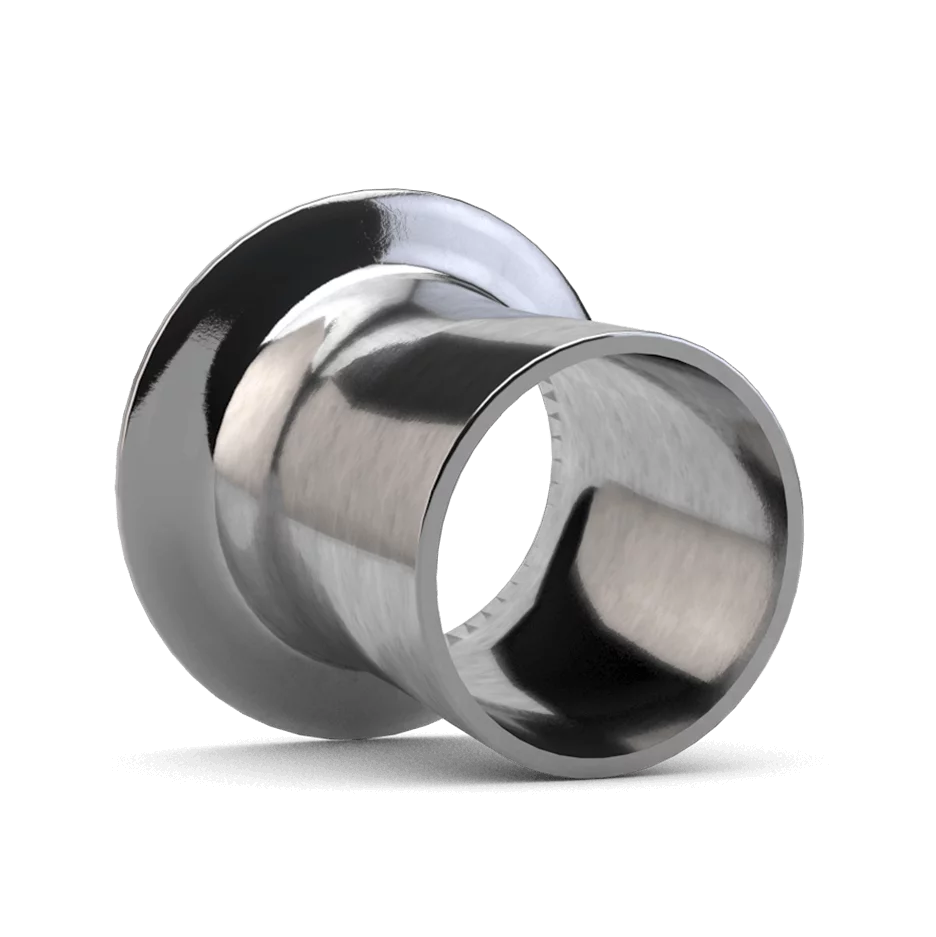
A stub end is a pipe fitting that forms a detachable pipe connection together with a loose backing flange — known in piping as a lap joint flange. The principle: the stainless steel collar is welded to the pipe and forms the actual sealing face, while the lap joint flange behind it takes the bolted connection. This flange with stub end design makes it possible to undo and realign the joint without dismantling the pipe system — a decisive advantage in maintenance-intensive industrial plants.
The combination of a lap joint flange with a stub end (a lap joint stub end) is especially common wherever:
● pipework has to be dismantled or cleaned regularly
● different flange materials are combined (e.g. a carbon-steel flange on a stainless-steel pipe)
● tight installation space makes a rigid welded flange difficult
● high operating temperatures call for special materials for the pipe-carrying component
At WITTE HiTEMP the focus is clearly on the last point: stainless steel collars and stub ends in heat-resistant grades for operating temperatures that standard materials cannot handle.
Which materials and dimensions are in stock?
WITTE HiTEMP supplies stub ends in high-temperature stainless steels designed for continuous service at temperatures of up to 1,150 °C. Unlike standard stainless steel collars (1.4404, 1.4571), these grades use alloys that retain their mechanical strength and oxidation resistance even under prolonged heat.
Available high-temperature grades (in stock):
● 1.4841 | AISI 314 – Very high scaling resistance, up to approx. 1,150 °C
● 1.4845 | AISI 310 S/H – Excellent high-temperature strength, up to approx. 1,100 °C
● 1.4878 | AISI 321 H – Titanium-stabilised, creep-resistant under sustained load
● 1.4835 | 253 MA – Outstanding oxidation resistance up to 1,100 °C, high yield strength
Dimensions and stock levels vary by material. Not every size is permanently available from stock in every grade — please get in touch with us directly.
hs. To which standards are the stainless steel collars manufactured?
The collars are manufactured to internationally recognised standards and are supplied as standard with inspection certificates to EN 10204. Further testing and certification are available on request.
Applicable standards:
● DIN 2642 – German standard for stub ends (lapped pipe ends) for loose / lap joint flanges
● EN 1092-1/37 – European flange standard, type 37 (collar / stub end)
● ASME B16.9 / MSS SP-43 – US standards for seamless and welded stainless-steel pipe fittings
Combining European and American compliance makes WITTE HiTEMP collars and stub ends suitable for international projects in petrochemicals, plant engineering and power generation.
What is the difference between a collar and a stub end?
Technically, both terms describe the same component — the difference lies in regional usage:
● Collar is the European technical term, common in piping to DIN and EN.
● Stub end is the English designation to ASME standards, used in American and international projects.
In practice, a stainless steel collar and a stub end are the same part: a lapped end that is welded to the pipe and combined with a loose backing flange. Whether you order stub ends to ASME or collars to EN, you receive a part matched to your standard and temperature class.
Which high-temperature applications are the collars suited for?
Wherever pipework is permanently exposed to high temperatures, material selection is decisive. The heat-resistant stainless steel collars from WITTE HiTEMP are typically used in the following fields:
● Thermal process plants – chemicals, petrochemicals, refineries
● Power plants and energy generation – flue-gas ducting, heat exchangers, steam systems
● Industrial burner and firing systems – heating plants, reformers, furnaces
● Exhaust and flue-gas systems – catalytic converters, exhaust lines in high-temperature zones
● Steel mills and metallurgical plants – pipework in direct heat zones
What matters in these applications is not just short-term temperature resistance, but creep strength under continuous thermal load. This is exactly what these materials are optimised for.
Why isn’t standard stainless steel enough at high temperatures?
One of the most frequent questions from planners and buyers: why not simply use 316L or 1.4571?
The answer lies in materials science: austenitic standard steels such as 1.4404 (316L) or 1.4571 (316Ti) are designed for operating temperatures up to approx. 500–600 °C. Above this, these materials begin to scale, lose strength and are damaged by oxidation.
The high-temperature grades — in particular 1.4841, 1.4845 and 1.4835 (253 MA) — have been developed specifically for resistance at temperatures above 800 °C through an increased chromium and silicon content. They form stable oxide layers that protect the base material, retain mechanical load-bearing capacity and are designed for continuous operation under thermal cycling.
For plants operated permanently at 900 °C, 1,000 °C or more, material choice is not a question of cost — it is a question of plant safety and service life.
Flange with stub end, loose flange or lapped flange – which connection is right?
● Stub end + lap joint flange: Detachable, easy to dismantle. Maintenance-intensive plants, mixed materials
● Weld neck flange: Permanently welded, high pressure rating. High-pressure systems
● Lapped flange (one-piece): Flared end, no separate flange. Simpler installation, fewer components
A flange with stub end — i.e. a lap joint flange running loose over the welded stub end — is the right choice when joints must be opened for maintenance or when different flange materials are combined. When selecting, consider operating pressure, temperature, accessibility and maintenance intervals. Our technical sales team will help you choose the right, standard-compliant connection.


